History is shaped by countless events, but certain developments have had particularly broad effects on how people live, communicate, work, govern, and understand the world. Some events transformed political institutions, while others changed technology, trade, religion, education, or social relationships.
Understanding major historical events helps explain why modern societies look different from those of previous centuries. It also shows that social and cultural change usually develops through a combination of ideas, institutions, technological developments, and human experiences.
The Development of Agriculture
The transition from hunting and gathering to agriculture was one of the most significant changes in human history. Farming allowed communities to establish more permanent settlements and produce food in more predictable ways.
As agricultural communities grew, populations increased and people developed specialized occupations. Larger settlements eventually contributed to the emergence of cities, governments, trade networks, and complex social structures.
Agriculture therefore influenced not only food production but also the organization of society.
The Rise of Early Cities and States
The emergence of cities and organized states changed how people lived together. Governments developed systems for taxation, administration, law, defense, and infrastructure.
Large settlements required ways to manage resources and resolve disputes. Written records became increasingly important for administration and trade.
The development of states laid foundations for political institutions that continued to evolve throughout history.
The Spread of Major Religions and Philosophies
The development and spread of major religious and philosophical traditions influenced societies across large geographic regions.
Religious ideas affected ethics, law, art, architecture, education, family life, and political institutions. Philosophical traditions encouraged people to debate questions about morality, knowledge, society, and human existence.
These traditions were transmitted through texts, teachers, travelers, institutions, and cultural exchange.
The Printing Revolution
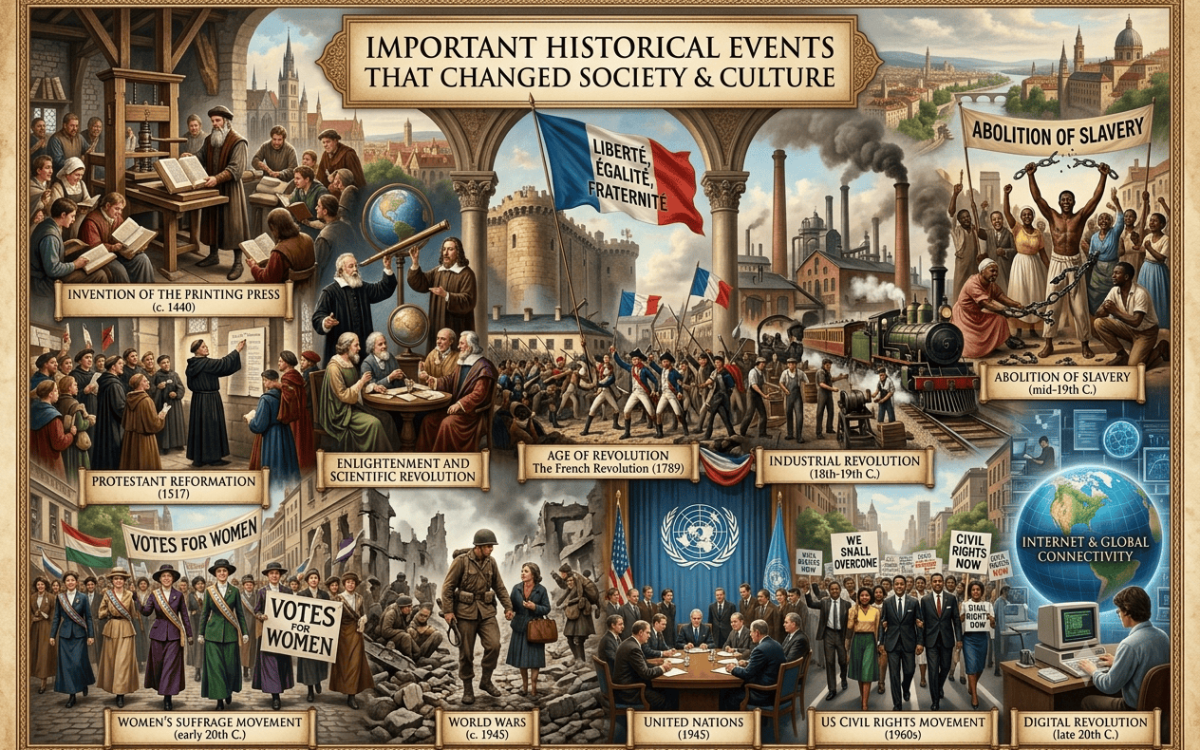
The development of mechanical printing in Europe, particularly associated with Johannes Gutenberg’s 15th-century printing press, transformed the production and distribution of written material.
Books could be reproduced more efficiently than handwritten manuscripts, contributing to wider access to texts.
Printing supported the spread of religious writings, scientific ideas, political arguments, literature, and educational material. Over time, increased access to written information contributed to broader changes in literacy and public discussion.
The Scientific Revolution
From roughly the 16th through 17th centuries, major developments in astronomy, physics, mathematics, and scientific methodology changed approaches to understanding the natural world.
Figures including Nicolaus Copernicus, Galileo Galilei, Johannes Kepler, and Isaac Newton contributed to developments in scientific thought.
The growing emphasis on observation, experimentation, mathematical reasoning, and evidence influenced later scientific research and eventually contributed to modern technology and medicine.
The Industrial Revolution
The Industrial Revolution transformed production, transportation, employment, and urban life. Beginning in Britain in the 18th century and spreading to other regions, industrialization introduced new machinery and production methods.
Factories expanded, transportation networks developed, and many people moved from rural areas to growing cities in search of employment.
Industrialization increased production and created new economic opportunities while also producing difficult working and living conditions in many places. Governments and societies subsequently developed new approaches to labor, public health, education, and urban management.
The Abolition of Slavery Movements
Movements against slavery developed across different regions and periods. In the 18th and 19th centuries, organized abolitionist campaigns contributed to legal changes in several countries.
The abolition of slavery did not immediately eliminate racial discrimination or economic inequality, and different societies experienced emancipation in different ways.
Nevertheless, abolition represented a major transformation in legal and social institutions and became part of broader struggles concerning freedom, equality, and human rights.
The World Wars
The First and Second World Wars had enormous effects on political borders, economies, populations, technology, and international relations.
The wars caused widespread destruction and loss of life while also accelerating developments in areas such as aviation, communications, medicine, and industrial production.
After the Second World War, international institutions were established or strengthened to address security, cooperation, reconstruction, and human rights.
Decolonization
During the 20th century, many countries in Asia, Africa, the Middle East, and elsewhere gained independence from European colonial rule.
Decolonization changed political boundaries and created new national governments. It also encouraged renewed attention to cultural identity, language, local traditions, and political self-determination.
The process varied significantly from one country to another and sometimes involved prolonged conflicts.
The Digital Revolution
The development of computers, the internet, mobile devices, and digital communication has transformed everyday life.
Information can now be created, copied, stored, and transmitted across the world almost instantly. Digital technology has changed education, business, entertainment, communication, journalism, and government services.
The digital revolution has also created new questions involving privacy, cybersecurity, employment, misinformation, and access to technology.
Social and Cultural Change Continues
Historical change does not stop with major events traditionally found in textbooks. Migration, technological innovation, social movements, economic changes, and cultural exchange continue to shape societies.
People today are experiencing changes in communication, employment, education, and relationships partly because of rapid technological development.